Updated — England permitted-development rules rechecked against Planning Portal guidance
Planning Permission Changes for EV Chargers in England (2026)
News analysis
What the 2025 England permitted-development changes mean for EV chargers, lawful off-street parking, listed buildings and on-street charging.
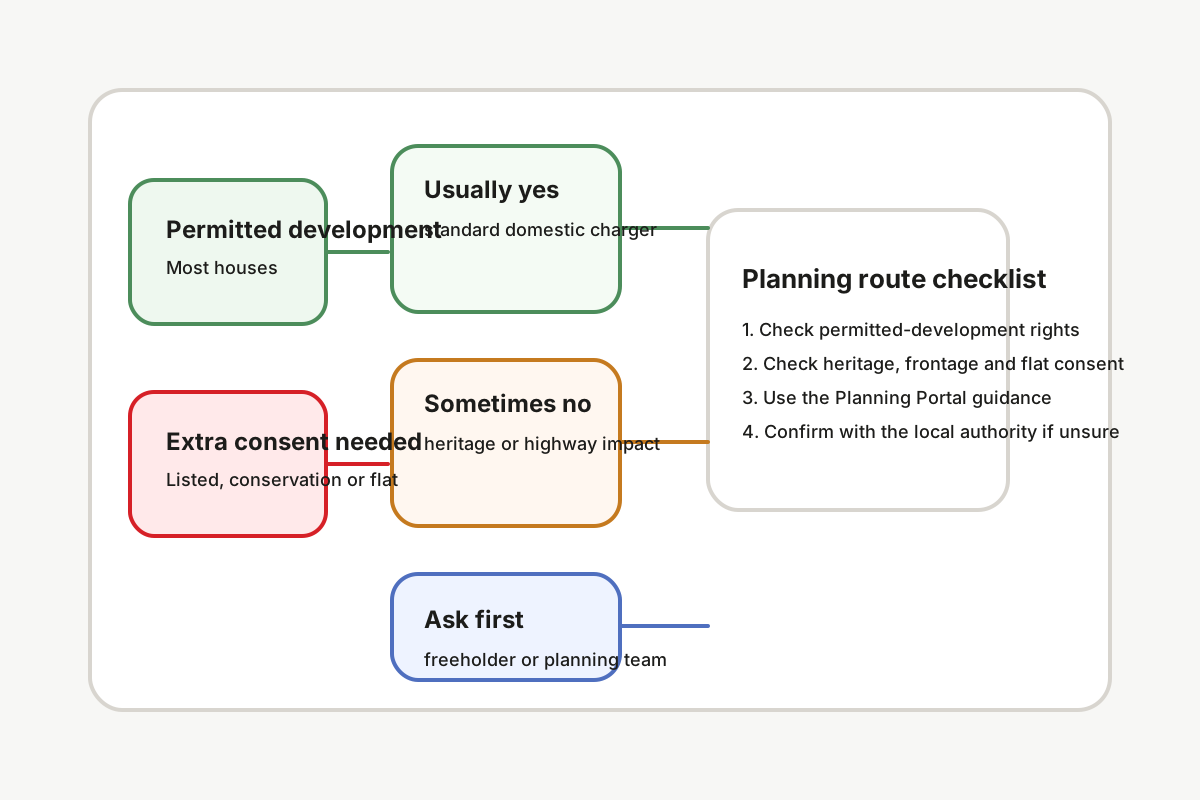
Permitted-development is the starting point, but listed buildings, Article 4 directions, conservation or protected sites, and on-street installations can change the answer.
Source: Planning Portal permitted-development guidance for EV chargers
The short version
In England, an EV charger installed in an area of lawful off-street parking will often benefit from permitted development rights. That means no planning application is normally needed, provided the charger and its location meet the relevant limits.
This is not a UK-wide rule. Planning is devolved: these England changes do not automatically apply in Wales, Scotland or Northern Ireland. The full decision guide on this site covers the wider installation questions; this page focuses on the England rule change.
What changed in 2025
The relevant permitted-development rights are set out in Schedule 2, Part 2, Classes D and E of the Town and Country Planning (General Permitted Development) (England) Order 2015, as amended.
The Planning Portal's current EV charging guidance explains the practical limits. The change removed some of the former highway-distance restrictions and clarified the permitted-development route for wall-mounted outlets and freestanding upstands.
Wall-mounted chargers — Class D
A wall-mounted charging outlet is generally permitted development when it serves lawful off-street parking, subject to the limits in the order. The outlet and casing must not:
- exceed 0.2 cubic metres
- be within a scheduled monument site
- be within the curtilage of a listed building
The fact that a charger is visible from a road does not, by itself, answer the question. Check the actual property, the parking arrangement and any local restriction.
Freestanding chargers — Class E
For a charger mounted on an upstand, the limits include:
- no more than 2.7 metres high from the parking surface, or 1.6 metres within the curtilage of a dwellinghouse or block of flats
- no more than one upstand for each parking space
- not within a scheduled monument site
- not within the curtilage of a listed building
If the proposal does not meet the limits, planning permission may be required. If the position is uncertain, ask the local planning authority about a Lawful Development Certificate before work starts.
Situations that still need care
Permitted development is not a universal exemption. Check before ordering if:
- the property is listed or within the curtilage of a listed building
- the site is a scheduled monument
- an Article 4 direction, planning condition or local restriction removes permitted-development rights
- the charger serves on-street parking rather than lawful off-street parking
- a cable would cross a pavement or highway
- you are in Wales, Scotland or Northern Ireland
Flats and rented properties also need the relevant freeholder, landlord or management-company consent. That is separate from planning permission.
Planning permission is not the whole installation
Even when no planning application is needed, the installation still needs to be designed and certified safely. Your installer should deal with the electrical requirements, Building Regulations/Part P obligations where applicable, DNO notification and any required highway or landowner consent.
Do not treat “no planning permission” as “no permission or paperwork of any kind”.
What to do next
For the complete decision tree covering flats, grants, charger choice, installation cost and the installer process, read our full planning permission guide. Then compare the current chargers and request installation quotes once the property constraints are clear.
Your next useful step: compare any two chargers head to head.