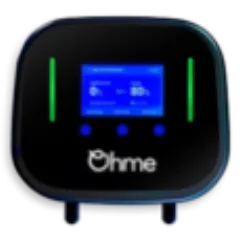
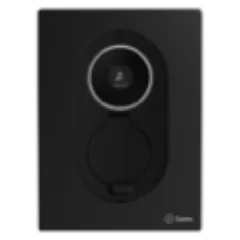
Ohme Home Pro vs Zaptec Go 2: Savings Today or a Bet on Tomorrow?
These two chargers represent fundamentally different philosophies. The Ohme Home Pro is laser-focused on cutting your electricity bill right now through deep smart tariff integration. The Zaptec Go 2 is a forward-looking piece of kit — the UK's first V2G-ready AC home charger — banking on a future where your Tesla feeds energy back to the grid for profit. At £535 versus £707, the question isn't just which is better, but which bet you want to make.
In a nutshell:
- Ohme Home Pro: Saves you money today with automated smart tariff charging. Tethered, convenient, proven.
- Zaptec Go 2: Future-proofed with V2G readiness, untethered flexibility, and a 5-year warranty.
Can the Zaptec Go 2's V2G Promise Justify the £172 Premium?
Let's be blunt: V2G on the Zaptec Go 2 is a promise, not a product. Tesla hasn't enabled AC vehicle-to-grid on any UK model, and the broader V2G ecosystem — the tariffs, the grid agreements, the regulatory framework — is still being built. You're paying £707 for hardware that's ready for something that doesn't fully exist yet.
That's not necessarily foolish. If you're planning to keep this charger for five or more years (and the 5-year warranty supports that), V2G could become transformative. Selling stored energy back during peak hours could theoretically offset your entire charging cost. But "could" and "theoretically" are doing a lot of heavy lifting in that sentence. If you want savings you can count on now, the Ohme's approach is far more concrete.
Does the Ohme Home Pro Actually Save You Money?
Yes, and it's not subtle. The Ohme connects directly to providers like Octopus Energy, OVO, and British Gas, pulling live pricing data and automatically shifting your charge sessions to the cheapest half-hour slots. Pair it with Octopus Intelligent Go and you're charging at around 7p/kWh — roughly a quarter of the standard rate. Over a year of typical driving, that difference adds up to hundreds of pounds.
The Zaptec Go 2 does have scheduled charging through its app, and its MID-approved energy meter gives you accurate consumption data. But it doesn't have the same native tariff integration. You can set timers manually, but you won't get the granular, half-hourly price optimisation that the Ohme handles automatically. If you're on a variable tariff like Octopus Agile, that distinction matters enormously.
Tethered vs Untethered: Which Setup Suits You?
This is a practical difference that gets overlooked. The Ohme Home Pro is tethered with a 5-metre Type 2 cable permanently attached — you pull up, plug in, done. The Zaptec Go 2 is untethered, meaning you use your own cable and store it between sessions.
For a single-car household with a dedicated driveway, tethered is almost always more convenient. You never forget a cable, never coil one up in the rain. But untethered has its advantages: if you have two EVs with different connector preferences (rare, since everything is Type 2 now, but possible), or if you want a tidier wall-mounted look, the Zaptec's socket-only design is cleaner. It also means less wear on a fixed cable over time.
One thing to flag: the Ohme's standard 5m cable might be tight if your charge port is on the far side of the car and your charger isn't ideally positioned. An 8m version is available at extra cost. The Zaptec sidesteps this entirely — just buy whatever cable length you need.
Solar Owners: The Ohme Has an Edge, But the Zaptec Isn't Far Behind
Both chargers support solar integration, but in different ways. The Ohme Home Pro has built-in solar diverting, routing surplus generation directly into your car. It's straightforward and handled through the same app you use for everything else. Our guide to the best EV chargers for solar covers this in detail.
The Zaptec Go 2 can auto-switch between single and three-phase charging to optimise solar usage, which is clever engineering — but on a standard UK single-phase supply, that capability is irrelevant. On single-phase, the Ohme's solar diverting is the more practical solution.
Which Should You Buy?
Buy the Ohme Home Pro if:
- You're on (or switching to) a smart energy tariff — this is where it earns back its cost fastest
- You want plug-in convenience with a tethered cable
- You have solar panels and want integrated diverting
- You'd rather save money now than bet on future tech
Buy the Zaptec Go 2 if:
- You specifically want an untethered charger with a clean wall-mount look
- A 5-year warranty matters more to you than a 3-year one
- You're genuinely excited about V2G and willing to wait for the ecosystem to mature
- You're on a three-phase supply and want 22kW capability
For most Tesla owners reading this today, the Ohme Home Pro is the smarter purchase. It's £172 cheaper, it actively reduces your bills from the first charge, and its smart tariff integration is best-in-class. The Zaptec Go 2 is a well-built charger with a genuinely interesting roadmap, but you're paying a premium for potential rather than proven savings. Check our best smart EV charger guide if you want to see how both stack up against the wider field.