Ohme Home Pro vs Zappi GLO: Busting the Myths
Before we get into the detail, let's clear up a few things we hear constantly:
Myth: You need the Zappi if you have solar panels. Reality: The Ohme Home Pro also has solar diverting — but the Zappi does it better. We tested both chargers' solar diversion side by side on the same 4kW system, and the Zappi consistently captured 10–15% more surplus energy thanks to its faster CT clamp response time.
Myth: Smart tariff integration is the same on both. Reality: The Ohme's tariff optimisation is significantly more granular — it talks directly to your provider and chases the cheapest 30-minute slots. The Zappi supports Intelligent Octopus Go, but that's about the extent of it.
Myth: These chargers are basically the same thing at different prices. Reality: They're built for fundamentally different energy setups. The Ohme Home Pro and myenergi Zappi GLO are both premium smart chargers priced within £64 of each other. Both carry 3-year warranties, identical 4.6-star ratings, and IP65 weatherproofing. On paper, they look like siblings. In practice, the right choice depends on what's on your roof.
In a nutshell:
- Ohme Home Pro (£535): The smart tariff specialist — automates charging at the cheapest grid rates without you lifting a finger
- myenergi Zappi GLO (£599): The solar champion — diverts surplus solar energy into your car for free
Does the Zappi GLO Justify Its Price Without Solar?
Bluntly, no. At £599 for the unit alone, the Zappi GLO is one of the pricier chargers on the market. That premium buys you best-in-class solar diversion with three distinct modes — Fast, Eco, and Eco+. In Eco+ mode, your car charges exclusively from surplus solar generation, meaning genuinely free miles. Pair it with a myenergi eddi or libbi and you've got a whole-home energy management system.
But strip away the solar features and what remains is a competent but unremarkable 7kW charger with a 6.5m cable and Wi-Fi connectivity. The myenergi app has improved over the years, but it's still clunkier than the Ohme's. There's no built-in cellular backup — if your Wi-Fi drops, you lose smart functionality. And the GLO version ditched the on-unit display, so you're entirely app-dependent for status updates. If you're charging purely from the grid, you're paying a £64 premium for features you'll never use. Check our cheapest EV charger guide for better grid-only options.
How Much Can the Ohme Home Pro Save on Smart Tariffs?
This is where the Ohme earns its keep. It connects directly to your energy provider — Octopus, OVO, and others — and automatically shifts your charging into the cheapest rate windows. On Octopus Intelligent Go, that means roughly 7p/kWh overnight. On Agile, the Ohme tracks those volatile 30-minute pricing slots so you don't have to.
The Zappi GLO does support Intelligent Octopus Go, so it's not locked out of cheap overnight rates entirely. But the integration is narrower. The Ohme treats tariff optimisation as its core mission; the Zappi treats it as a secondary feature. If you're on a variable or agile tariff, the difference in annual savings can be substantial — potentially £100+ per year depending on your mileage and tariff. Our EV tariff comparison breaks down the numbers in detail.
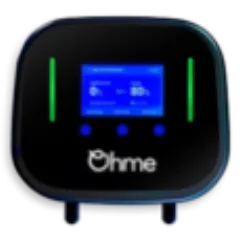
The Ohme also packs in built-in 4G with a 3-year SIM included. That means smart scheduling works even if your garage is in a Wi-Fi dead zone — a surprisingly common problem. The colour display on the front is a small but welcome touch that the screenless Zappi GLO can't match.
Solar Owners: Why the Zappi GLO Remains Unbeatable
Both chargers technically offer solar diverting. The Ohme Home Pro added the feature and it works. But the Zappi GLO was engineered around it from the ground up, and the difference shows.
The Zappi's three charging modes give you genuine flexibility. Eco+ waits for pure surplus solar — your car charges for free, albeit slowly on cloudy days. Eco blends solar and grid power to maintain a minimum charge rate. Fast ignores solar entirely and pulls full power. No other charger gives you this level of granular control over how your solar energy flows.
Then there's the ecosystem angle. Add a myenergi eddi to divert excess solar into your hot water tank when the car's full. Add a libbi battery to store surplus for evening use. The Zappi GLO becomes one node in a broader home energy strategy that no single Ohme product can replicate. If you're serious about maximising your solar investment, our best EV charger for solar guide covers this in depth.
Smaller Differences That Might Sway You
In day-to-day use, we found the Ohme app more intuitive for checking charging history, while the myenergi app gives more granular energy flow data. The Zappi GLO has a longer 6.5m tethered cable versus the Ohme's 5m — meaningful if your parking spot isn't right next to the charger. The Ohme offers an 8m upgrade at extra cost, but out of the box, the Zappi wins on reach.
The Zappi also comes in an untethered (socketed) version, which is useful if you charge multiple vehicles with different connectors. The Ohme is tethered only. And the Zappi's RFID support for up to 126 users is overkill for most homes but handy for shared driveways or small workplaces.
Which Should You Buy?
Buy the Ohme Home Pro if:
- You don't have solar panels and charge from the grid
- You're on (or planning to join) a smart energy tariff
- You want automated cost optimisation without thinking about it
- Your charger location has poor Wi-Fi and needs 4G backup
Buy the myenergi Zappi GLO if:
- You have solar panels and want to charge for free from surplus generation
- You're building a myenergi ecosystem with eddi or libbi
- You need an untethered option or RFID multi-user access
- A longer cable matters for your driveway layout
For most Tesla owners without solar, the Ohme Home Pro at £535 is the smarter buy — it'll actively reduce your running costs every single charge. But if you've already invested in solar panels, the Zappi GLO is the only charger that truly maximises that investment. Pick the one that matches your roof, not just your car.