Zaptec Go 2 vs Sync Energy Wall Charger 2: Future-Proofed or Budget-Smart?
Future-Proofed Premium vs Budget-Smart Value: Two Very Different Philosophies
These two chargers sit at opposite ends of the UK home charging market, and the fact that you're weighing them up tells us something interesting about where your priorities lie. The Zaptec Go 2 arrives at £707 with a bold claim: it's the UK's first V2G-ready AC home charger, built for a future where your Tesla feeds power back to the grid. The Sync Energy Wall Charger 2 takes a radically different approach — deliver every smart feature most drivers actually need today, and do it for roughly half the price.
The gap between them isn't just about money. It's about whether you're buying for 2026 or for 2030. One charger bets on emerging technology; the other bets on proven value. Both are OZEV-approved, both support OCPP 1.6J for third-party energy management, and both will happily charge any Tesla or UK EV overnight. But the similarities largely end there.
In a nutshell:
- Zaptec Go 2 (£707): The UK's first V2G-ready AC home charger with free 4G connectivity and a MID-approved energy meter — built for drivers who want to be ahead of the curve.
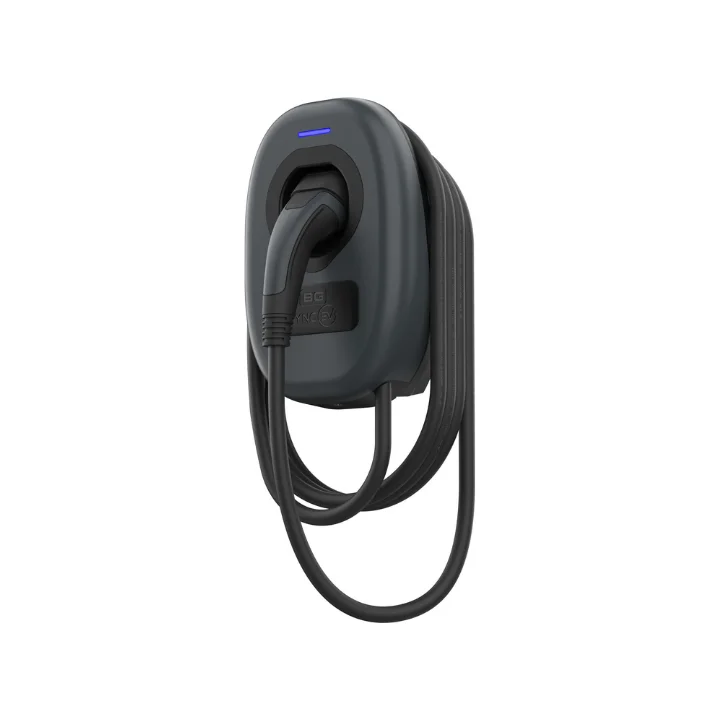
- Sync Energy Wall Charger 2 (£362): A feature-packed budget charger with solar diversion, dynamic load balancing, and built-in PEN fault protection — outstanding value from a UK-backed brand.
Spec Comparison
| Feature | Zaptec Go 2 | Sync Energy Wall Charger 2 |
|---|---|---|
| Price | £707 | £362 (socketed) / from £302 (tethered) |
| Max Power | 7.4kW (1-phase) / 22kW (3-phase) | 7.4kW (single-phase only) |
| Cable | Untethered (bring your own) | Untethered or tethered (7.5m cable) |
| Smart Tariff Support | Scheduled charging via Zaptec app | TariffSense scheduling |
| Solar Integration | Auto-switches between 1 and 3-phase for solar | SolarCharge with CT clamp |
| Connectivity | Wi-Fi, 4G (subscription-free), Bluetooth | Wi-Fi, Ethernet, Bluetooth |
| Warranty | 5 years | 3 years |
| IP Rating | IP54 | IP65 + IK10 |
| Type | Untethered only | Untethered or tethered |
| V2G Ready | Yes | No |
| OCPP 1.6J | Yes | Yes |
Smart Features and Connectivity
The Zaptec Go 2's standout connectivity advantage is its subscription-free 4G. If your Wi-Fi doesn't reliably reach your driveway — and let's be honest, plenty of UK homes have this problem — the Go 2 simply falls back to cellular without costing you a penny extra. As topcharger.co.uk noted in their review of the original Zaptec Go, the always-online approach via Wi-Fi or 4G LTE-M means the charger stays connected for OTA updates and app control. The Go 2 continues this tradition, and the MID-approved energy meter adds accurate billing data that could prove invaluable as time-of-use tariffs become more sophisticated.
The Sync Energy Wall Charger 2 counters with TariffSense scheduling, SolarCharge solar diversion, and dynamic load balancing — three features that deliver real savings right now. It also offers Ethernet connectivity alongside Wi-Fi and Bluetooth, which is a sensible fallback for homes with weak wireless signals, though it does require running a cable. However, some users have reported Wi-Fi reliability issues at range, and the base model lacks 4G entirely — you'd need the GG variant for cellular, which adds cost. The app platform transition from Monta also caused early confusion, though this should be settled by now.
Both chargers support OCPP 1.6J, which means they can work with third-party energy management systems — a genuine future-proofing feature regardless of which you choose.
Solar Integration and V2G
If you've got solar panels on your roof — or plan to — both chargers offer solar-aware charging, but they go about it differently. The Zaptec Go 2 can auto-switch between single and three-phase charging to optimise solar self-consumption. On a three-phase supply (rare in UK homes, but increasingly common in new builds), this flexibility is genuinely useful. The Sync Energy Wall Charger 2 uses a CT clamp-based SolarCharge system that diverts excess solar generation to your car — a proven, practical approach that works well on the standard single-phase supplies most of us have.
The elephant in the room is V2G. The Zaptec Go 2 is marketed as V2G-ready, meaning it's designed to support vehicle-to-grid technology when the UK infrastructure and vehicle compatibility catch up. In theory, your Tesla could eventually feed stored energy back to the grid during peak demand, earning you money. In practice, V2G via AC is still in its infancy in the UK, and most current V2G trials use DC technology. You're paying a premium today for a feature that may take years to deliver real-world value. As evenergyhub.com highlights, matching your charger to your current energy ecosystem matters more than chasing emerging tech.
Build Quality and Design
Zaptec's Scandinavian design heritage shows in the Go 2. At just 240mm × 180mm × 106mm and approximately 3.2 kg, it's remarkably compact — zaptec.com describes the original Go as no bigger than an iPad, and the Go 2 maintains that discreet footprint. The five-year warranty is a significant confidence statement, sitting well above the industry average.
The Sync Energy Wall Charger 2 is larger at 305mm × 201mm × 115mm and heavier at 4–5 kg, with what the data describes as a conservative, functional design. However, it fights back with nine interchangeable fascia colour options to match your property, plus a superior IP65 rating with IK10 impact resistance — meaning it's fully weatherproof and can shrug off a knock from a wayward football or bike handlebar. Its three-year warranty is respectable but falls short of the Zaptec's five years.
Installation Considerations
The Sync Energy Wall Charger 2 has a notable installation advantage: built-in PEN fault protection. This eliminates the need for an earth rod, which can save £50–150 on installation costs and avoids the hassle of driving a rod into potentially rocky or concreted ground. As localev.uk notes, features like PEN fault protection and load balancing make a genuine practical difference to installation complexity and cost. The Zaptec Go 2 also includes PEN fault detection according to Zaptec's specifications, so both chargers should avoid the earth rod requirement.
Both are OZEV-approved, meaning eligible renters and flat owners can claim up to £500 off installation costs.
Price and Value
| Cost | Zaptec Go 2 | Sync Energy Wall Charger 2 |
|---|---|---|
| Unit price | £707 | £362 (socketed) / from £302 (tethered) |
| Installation estimate | £400–600 | £300–600 |
| Total installed cost | £1,107–1,307 | £602–962 |
| After OZEV grant | £607–807 | £102–462 |
The price difference is stark. At the extremes, you could install a tethered Sync Energy Wall Charger 2 for under £600 after the OZEV grant — potentially less than the Zaptec Go 2 unit alone. That's a saving of £345–505 on hardware, which could cover a year or more of home charging on a smart tariff like Octopus Intelligent Go at roughly 7p/kWh.
The Zaptec justifies its premium through V2G readiness, free 4G, a MID-approved meter, and a longer warranty. Whether those extras are worth nearly double the price depends entirely on your outlook. If V2G becomes mainstream and profitable within the Go 2's lifespan, early adopters will look very clever indeed. If it doesn't, the Sync Energy delivers almost every practical feature you need today for significantly less.
Who Should Buy Which?
Buy the Zaptec Go 2 if:
- You want to be genuinely future-proofed for V2G technology as it matures in the UK
- Your Wi-Fi doesn't reach your charging spot and you want hassle-free 4G at no ongoing cost
- You value a MID-approved energy meter for precise billing and tariff tracking
- You have or plan a three-phase supply and want up to 22kW charging capability
- A five-year warranty and compact Scandinavian design matter to you
Buy the Sync Energy Wall Charger 2 if:
- Budget is a priority and you want the most features per pound spent
- You have solar panels and want proven CT clamp-based solar diversion today
- You prefer a tethered option with a 7.5m cable included — no fumbling for a separate lead
- You want dynamic load balancing and built-in PEN fault protection to simplify installation
- You'd rather have nine colour options to match your property's exterior
Our recommendation: For the majority of UK homeowners charging a Tesla or other EV on a single-phase supply, the Sync Energy Wall Charger 2 offers genuinely impressive value. It covers solar diversion, smart scheduling, load balancing, and PEN fault protection at a price that's hard to argue with. The Zaptec Go 2 is the better charger on paper — the V2G readiness, free 4G, and longer warranty are real advantages — but you're paying a significant premium for technology that hasn't yet matured in the UK market. If you're the type who buys the first generation of everything and enjoys being ahead of the curve, the Go 2 won't disappoint. For everyone else, the Sync Energy is the smarter spend right now.
For the full specs-level breakdown, see our Zaptec Go 2 vs Sync Energy Wall Charger 2 comparison page.
Read our full Zaptec Go 2 review or Sync Energy Wall Charger 2 review.
For total installed cost rankings, see our cheapest EV charger guide.
We’ll handle the installation
We’ll match you with vetted UK electricians — up to 3 free quotes, no obligation.