Wallbox Pulsar Max vs Sync Energy Wall Charger 2: Premium Compact vs Budget Bargain
Premium Compact vs Budget Bargain: Is the Wallbox Pulsar Max Worth Nearly Double?
These two chargers sit at opposite ends of the UK home charging market, yet both do the same fundamental job: safely deliver 7.4kW to your Tesla (or any other EV) overnight. The Wallbox Pulsar Max has earned a reputation as one of the sleekest, most compact chargers you can bolt to a wall, backed by a generous 5-year warranty and the option of three-phase charging. The Sync Energy Wall Charger 2, meanwhile, undercuts it by a staggering £337 while still packing in solar diversion, dynamic load balancing, and smart tariff scheduling — all backed by UK-listed parent company Luceco PLC.
So why would anyone pay nearly double? That is the question this comparison sets out to answer. If you are a Tesla owner with a driveway, single-phase supply, and a keen eye on the budget, the answer might surprise you.
In a nutshell:
- Wallbox Pulsar Max (£496): The most compact charger on the market with three-phase capability, voice control, and a class-leading 5-year warranty.
- Sync Energy Wall Charger 2 (£362): A feature-rich UK-designed charger at a remarkable price, with built-in PEN fault protection, solar diversion, and a longer cable.
Spec Comparison
| Feature | Wallbox Pulsar Max | Sync Energy Wall Charger 2 |
|---|---|---|
| Price (unit only) | £496 | £362 (socketed); from £302 (tethered) |
| Max Power Output | 7.4kW (single-phase) / 22kW (three-phase) | 7.4kW (single-phase only) |
| Cable Type | Tethered or untethered (Type 2) | Tethered or untethered (Type 2) |
| Cable Length | 5 metres | 7.5 metres |
| Smart Tariff Support | No built-in tariff integration | TariffSense scheduling |
| Solar Integration | Eco-Smart (requires separate Power Meter) | SolarCharge with CT clamp |
| Connectivity | Bluetooth, Wi-Fi | Wi-Fi, Ethernet, Bluetooth |
| Warranty | 5 years | 3 years |
| IP / IK Rating | IP54 / IK10 | IP65 / IK10 |
| Dimensions | 198 × 201 × 99 mm | 305 × 201 × 115 mm |
| Weight | ~4.2 kg | ~4–5 kg |
| OZEV Approved | Yes | Yes |
Smart Tariff Integration
This is where the Sync Energy charger quietly pulls ahead. Its TariffSense feature lets you schedule charging around cheap off-peak windows — ideal if you are on Octopus Go (7.5p/kWh between 00:30 and 04:30) or a similar smart tariff. For a typical Tesla Model 3 owner covering the UK average of 7,400 miles per year, that works out to roughly 2,114 kWh annually. Charging at 7.5p/kWh instead of a standard 24.5p/kWh variable rate saves you around £359 a year — which, coincidentally, is almost exactly the price of the Sync Energy unit itself.
The Wallbox Pulsar Max, by contrast, offers scheduled charging through the myWallbox app but lacks the kind of native smart tariff integration you get with chargers like the Ohme or, indeed, the Sync Energy. You can still set timers manually to hit off-peak windows, but it requires more effort on your part and will not automatically adjust if your tariff structure changes. As electriccarguide.co.uk noted in their Wallbox review, the app is intuitive but "lacks some advanced options" — and tariff-aware charging is one of those gaps.
Solar Diversion
Both chargers support solar integration, but they take different approaches — and one costs more than the other to get going. The Sync Energy Wall Charger 2 includes SolarCharge functionality with a CT clamp, meaning it can divert surplus solar energy to your EV without needing additional hardware purchases. If you have got a 4kW solar array on your roof, this feature lets you soak up free electricity during the day rather than exporting it back to the grid at roughly 15p/kWh.
The Wallbox Pulsar Max offers its own Eco-Smart solar feature, but it requires a separate Wallbox Power Meter at additional cost. That is an extra expense on top of an already pricier unit. For homeowners who already have solar panels — or are planning an installation — the Sync Energy's all-in approach is significantly more wallet-friendly. As wallbox.com highlights, the Pulsar Max can "connect with solar or home battery systems," but the added hardware requirement is worth factoring into your total budget.
Build Quality and Design
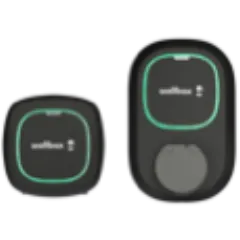
Here is where the Wallbox Pulsar Max genuinely earns its premium. At just 198 × 201 × 99 mm, it is one of the smallest home chargers you can buy — roughly the size of a hardback book. The six colour options let you match it to your property, and the RGB LED halo gives clear charging status feedback. If your charger is on a prominent front wall, the Pulsar Max simply looks better than almost anything else on the market. tinyeco.com ranked it among the best home EV chargers for 2025, and bestchargers.co.uk gave it a 4.5 rating.
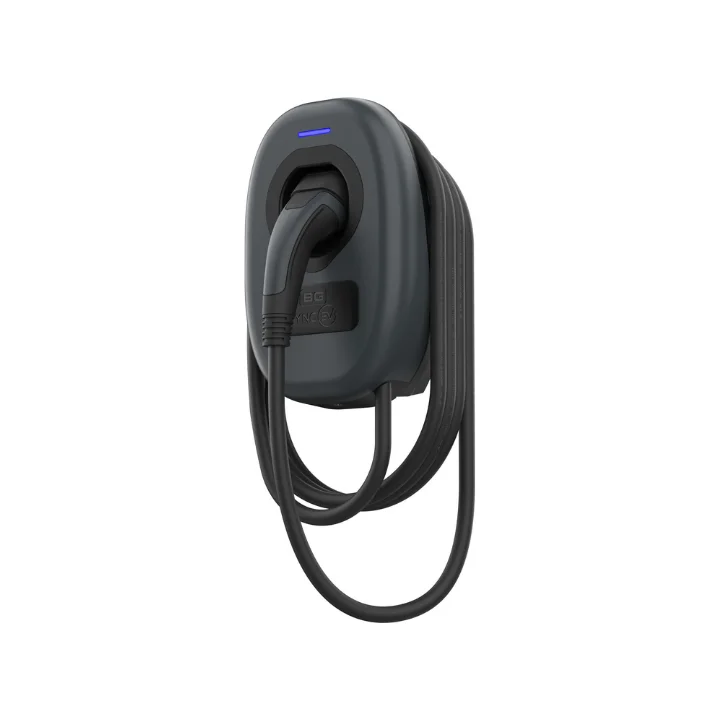
The Sync Energy Wall Charger 2 is larger at 305 × 201 × 115 mm, and its design is more functional than eye-catching. That said, it offers interchangeable fascia plates in nine colours, which is a nice touch. It also wins on weatherproofing: its IP65 rating means it is fully protected against water jets from any direction, versus the Pulsar Max's IP54 which covers splashes only. Both share an IK10 impact resistance rating, so either will shrug off an errant football or wayward wheelie bin. For exposed coastal or rural installations, the Sync Energy's superior IP rating is a genuine practical advantage.
The Sync Energy also comes with a 7.5-metre tethered cable versus the Pulsar Max's 5 metres — a meaningful difference if your parking spot is not directly beside the charger. That extra 2.5 metres can save you hundreds on installation costs by avoiding a longer cable run.
Installation Considerations
Both chargers are OZEV-approved, so eligible renters and flat owners can claim up to £500 off installation costs. The Sync Energy has a notable edge here: built-in PEN fault protection means no earth rod is required, which simplifies installation and can shave £100–200 off the total bill. The Wallbox Pulsar Max data does not specify built-in PEN protection, so your installer may need to fit an earth rod depending on your property's earthing arrangement — an additional cost and a small patch of dug-up driveway.
The Sync Energy also offers Ethernet connectivity alongside Wi-Fi and Bluetooth, which is useful if your Wi-Fi signal does not reach your garage or driveway reliably. Some user reviews have flagged Wi-Fi connectivity issues with the Sync Energy at range, so having that wired backup is a sensible inclusion. The Pulsar Max relies on Wi-Fi and Bluetooth only, with no 4G or Ethernet fallback.
Price and Value
| Cost Element | Wallbox Pulsar Max | Sync Energy Wall Charger 2 |
|---|---|---|
| Unit price | £496 | £362 (socketed) / from £302 (tethered) |
| Typical installation | £400–600 | £300–600 |
| Total installed cost | £896–1,096 | £602–962 |
| After OZEV grant (if eligible) | £396–596 | £102–462 |
The Sync Energy still holds a clear price advantage. At the lower end of installation costs, the fully installed Sync Energy can come in under £700 — significantly less than the Wallbox's £896–£1,096 range. The Sync Energy's built-in PEN fault protection should also keep installation costs towards the lower end of the range.
Where the Pulsar Max claws back value is in its 5-year warranty versus the Sync Energy's 3 years, and in its three-phase capability for the rare UK property that supports 22kW charging. If you are in a new-build with three-phase power, the Pulsar Max is one of the few compact chargers that can deliver the full 22kW — cutting a 60kWh battery charge from roughly 8.5 hours down to about 2.7 hours.
Who Should Buy Which?
Buy the Wallbox Pulsar Max if:
- Your charger will be on a prominent, visible wall and aesthetics matter to you
- You have (or plan to get) a three-phase power supply and want 22kW charging
- You value a longer 5-year warranty for peace of mind
- You use Alexa or Google Assistant and want voice-controlled charging
- Space is extremely tight and you need the smallest possible unit
Buy the Sync Energy Wall Charger 2 if:
- You want the best value smart charger with solar diversion included
- You are on a smart tariff like Octopus Go and want TariffSense scheduling
- You need a longer cable — 7.5 metres versus 5 metres
- You want to avoid earth rod installation thanks to built-in PEN fault protection
- You prefer a UK-designed product backed by a listed UK company
Our recommendation: For the majority of UK Tesla owners on a single-phase supply, the Sync Energy Wall Charger 2 is the smarter buy. It delivers more features that actually save you money — TariffSense scheduling, integrated solar diversion without extra hardware, and built-in PEN protection that reduces installation costs. At roughly half the price of the Pulsar Max, it pays for itself faster through smart tariff savings alone. The Wallbox Pulsar Max remains the better choice if you need three-phase charging, prioritise a compact premium design, or simply want the reassurance of a 5-year warranty. But for pure value? The Sync Energy is hard to argue with.
For the full specs-level breakdown, see our Wallbox Pulsar Max vs Sync Energy Wall Charger 2 comparison page.
Read our full Wallbox Pulsar Max review or Sync Energy Wall Charger 2 review.
For total installed cost rankings, see our cheapest EV charger guide.
We’ll handle the installation
We’ll match you with vetted UK electricians — up to 3 free quotes, no obligation.