NexBlue Point 2 vs VCHRGD Seven Pro: Future-Proof Tech vs Best-Value Bundle
Future-Proof Tech vs Best-Value Bundle
Here's a matchup that perfectly captures the new wave of UK home EV chargers: two relatively young brands, both undercutting the established players on price, both stuffing their units with features you'd normally only find on chargers costing £200 more. The NexBlue Point 2 and the VCHRGD Seven Pro are fighting over the same customer — the savvy buyer who wants smart tariff support, solar compatibility, and dynamic load balancing without paying Zappi money.
But they take meaningfully different approaches. The NexBlue Point 2 bets big on future-proofing, packing in ISO 15118, V2G readiness, and OCPP 2.0.1 support at a price that makes established brands look sluggish. The VCHRGD Seven Pro, meanwhile, focuses on delivering the most practical features per pound right now — a tethered cable, two solar charging modes, RFID cards in the box, and an AI-powered app, all for under £450. If you're torn between these two, you're really choosing between investing in tomorrow's technology or maximising today's value.
In a nutshell:
- NexBlue Point 2 (£530): V2G-ready and ISO 15118 compliant — the most future-proofed charger at this price point.
- VCHRGD Seven Pro (£432): Arguably the most features per pound on the UK market, with a tethered cable, dual solar modes, and RFID included.
Spec Comparison
| Feature | NexBlue Point 2 | VCHRGD Seven Pro |
|---|---|---|
| Price | £530–£600 | £432 (tethered 7.5m) / from £395 (untethered) |
| Power | 7.4kW (single-phase) | 7.4kW (single-phase) |
| Cable | Untethered only (Type 2 socket) | Tethered 7.5m or untethered |
| Smart tariffs | EcoPilot tariff integration | Octopus Intelligent Go integration |
| Solar | Solar surplus (requires NexBlue Zen accessory) | Solar Export + Solar Only modes |
| Load balancing | CT clamp included | CT clamp included |
| Connectivity | Wi-Fi, Bluetooth, 4G eSIM (lifetime free) | Wi-Fi, Bluetooth (optional 4G) |
| Protocols | OCPP 1.6-J + 2.0.1, ISO 15118 | OCPP 1.6J |
| Warranty | 5 years | 3 years |
| IP / IK Rating | IP54 + IK10 | IP54 + IK10 |
| Weight | 2.1 kg | ~4 kg (tethered) |
| Type | Untethered only | Tethered or untethered |
Smart Tariff Integration
Both chargers promise to save you serious money by shifting your charging to off-peak hours — the single biggest financial advantage of owning a home charger. On a tariff like Octopus Intelligent Go at around 7p/kWh, charging a Tesla Model 3 costs roughly 2p per mile versus 7–8p on a standard variable rate. Over 7,400 miles of average annual driving, that's a difference of around £400 a year.
The VCHRGD Seven Pro integrates directly with Octopus Intelligent Go through the Powerverse app, which is a well-known and specific tariff pairing. If you're already on Intelligent Go — or planning to switch — this is a straightforward, proven combination. The app also includes a Raya AI assistant for scheduling and energy insights, which is a nice touch at this price.
The NexBlue Point 2 takes a broader approach with its EcoPilot system, which automatically charges at the cheapest rates on your tariff. NexBlue's app — myNexBlue — handles the scheduling, and the charger's built-in 4G eSIM means it stays connected even if your home Wi-Fi doesn't reach the driveway. That lifetime free 4G connectivity is a genuine differentiator; most rivals either lack 4G entirely or charge a subscription for it.
Solar Diversion
If you have solar panels — or plan to install them — both chargers offer solar surplus charging, but the implementations differ in important ways.
The VCHRGD Seven Pro includes two distinct solar modes out of the box: Solar Export, which uses excess energy that would otherwise be exported to the grid, and Solar Only, which charges exclusively from solar generation. The CT clamp is included, so there's nothing extra to buy. For a charger at £432, having dual solar modes with no additional hardware is exceptional value — it's the kind of feature set you'd expect from a Myenergi Zappi at nearly double the price. As evenergyhub.com notes, matching your charger to your energy ecosystem is what delivers maximum long-term savings.
The NexBlue Point 2 supports solar surplus charging too, but with a caveat: while the CT clamp for dynamic load balancing is included, the full solar diversion capability requires the NexBlue Zen accessory — a wireless sensor that communicates via cloud or local radio frequency, as detailed on the nexblue.com product page. That's an additional cost and an extra piece of hardware. If solar is a primary motivation for your purchase, the VCHRGD has the edge on out-of-box simplicity.
App and Connectivity
Connectivity is where the NexBlue Point 2 flexes hardest. Triple connectivity — Wi-Fi, Bluetooth, and 4G eSIM with a lifetime free subscription — means this charger will stay online regardless of your home network situation. Anyone who's experienced the frustration of a smart charger dropping off Wi-Fi mid-schedule will appreciate this. The unit also supports RFID and NFC activation, and OTA updates keep the firmware current.
The VCHRGD Seven Pro offers Wi-Fi and Bluetooth as standard, with optional 4G available. It includes two RFID cards in the box, which is genuinely useful if you share a driveway or want to manage access for guests. The Powerverse app handles scheduling, solar modes, and energy monitoring, though it's worth noting this is a third-party platform rather than a proprietary VCHRGD system — long-term continuity depends on that partnership holding firm.
Where the NexBlue truly stands apart is protocol support. OCPP 2.0.1 and ISO 15118 readiness mean this charger is prepared for V2G (vehicle-to-grid) bi-directional charging and Plug & Charge functionality. Today, that's mostly theoretical for UK home users — but when V2G tariffs and services arrive, you won't need to replace your hardware. The VCHRGD supports OCPP 1.6J, which is perfectly adequate for current smart charging needs but doesn't offer the same upgrade path.
Build Quality and Design
Both chargers share an IP54 weatherproof rating with IK10 impact resistance — the highest impact rating you'll find on a home charger, meaning they'll shrug off accidental knocks, footballs, and the general indignities of British driveways.
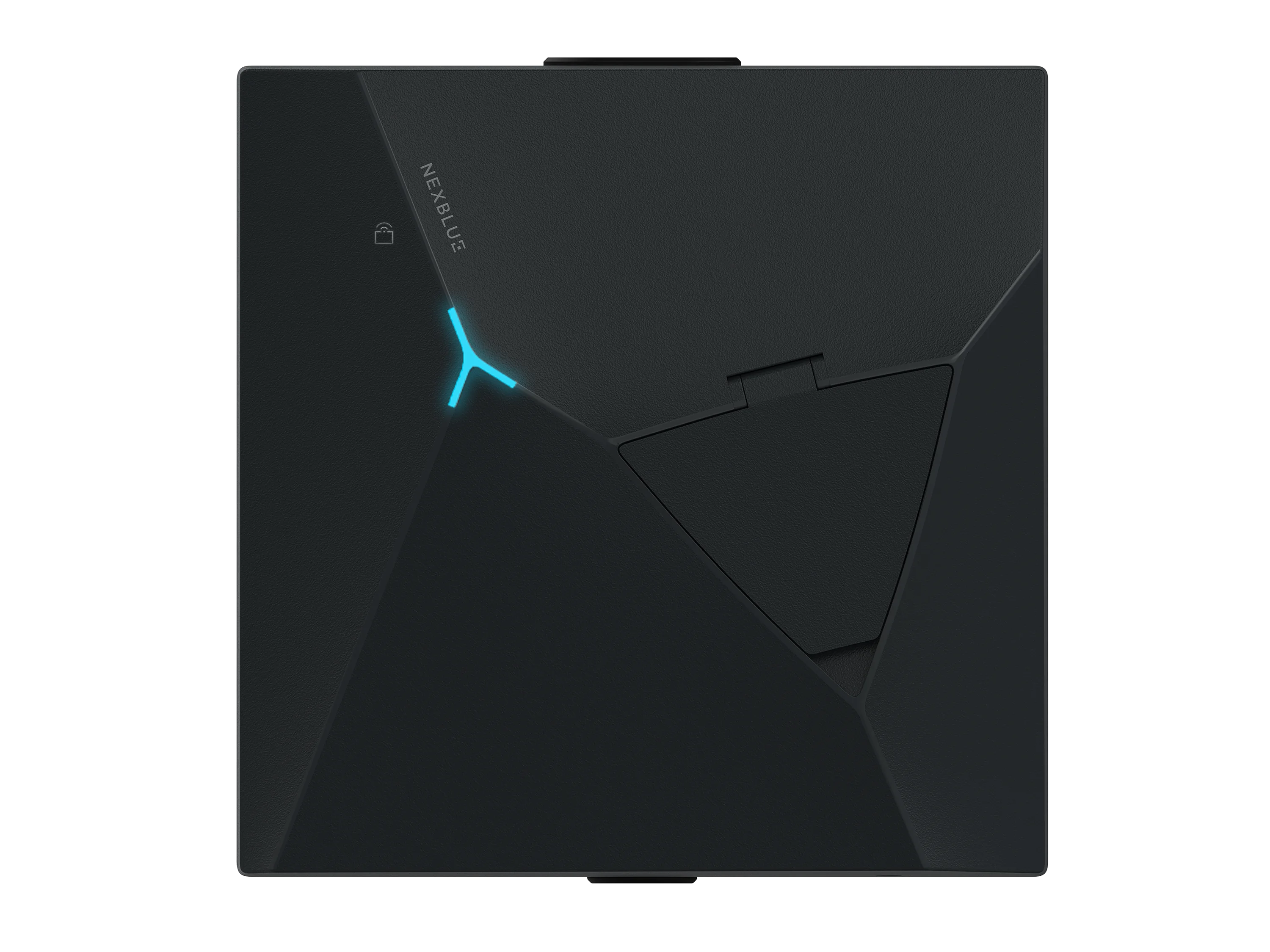
The NexBlue Point 2 is remarkably compact and light at just 2.1 kg and 235mm × 230mm × 107mm. NexBlue describes the design as inspired by space and meteorites, and with 19 built-in sensors for protection and safety, it's a dense little unit. The backplate design reportedly allows installation in under four minutes, as highlighted on their product page. It's only available in Space Black.
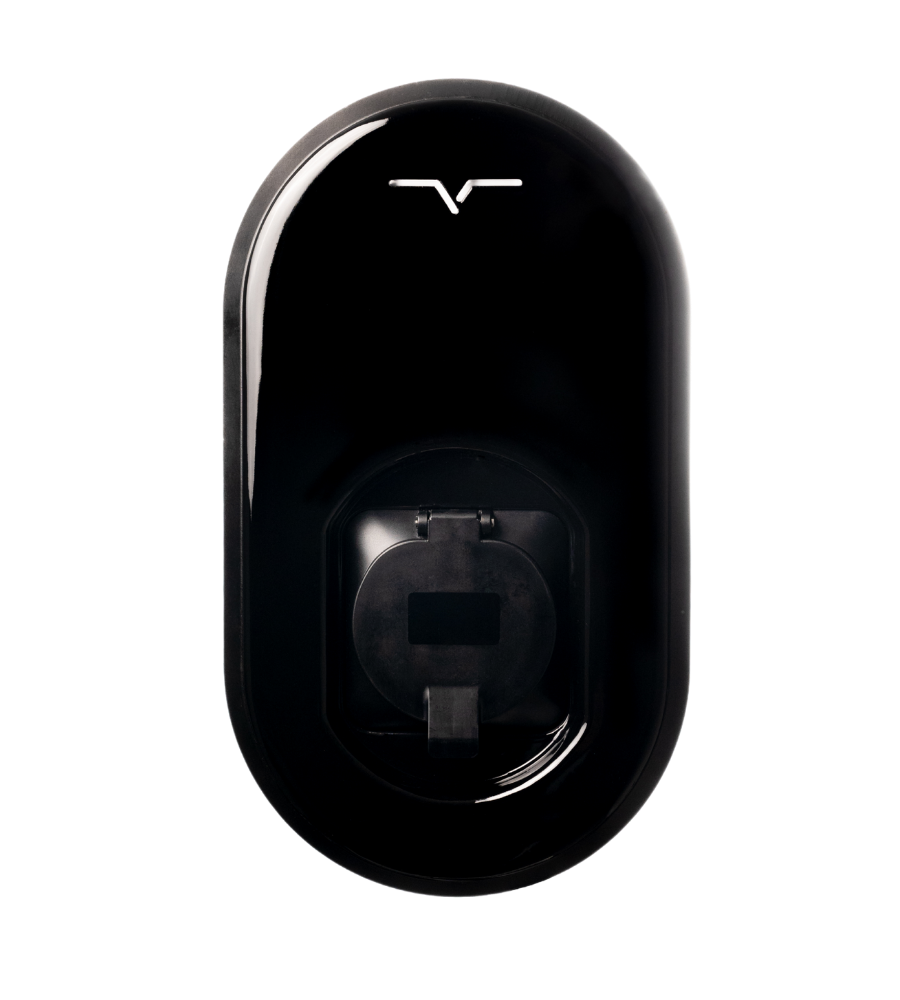
The VCHRGD Seven Pro is slightly larger at 300mm × 180mm × 90mm and around 4 kg with the tethered cable, but still compact by charger standards. It's also only available in black. Both chargers are TUV/CE certified, with the VCHRGD carrying specific OLEV/OZEV approval.
Price and Value
| Cost element | NexBlue Point 2 | VCHRGD Seven Pro |
|---|---|---|
| Unit price | £530–£600 | £432 (tethered) / £395 (untethered) |
| Typical installation | £400–£600 | £400–£600 |
| Total installed cost | £930–£1,200 | £832–£1,032 |
| After OZEV grant (if eligible) | £430–£700 | £332–£532 |
The VCHRGD Seven Pro is the clear value winner on upfront cost — potentially £100–£170 cheaper than the NexBlue for the tethered version, and even more if you opt for its untethered variant at £395. For that lower price, you get a tethered cable, two RFID cards, dual solar modes, and dynamic load balancing with CT clamp included.
The NexBlue Point 2 costs more but delivers features that no other charger at this price offers: V2G readiness, ISO 15118, OCPP 2.0.1, and lifetime free 4G. The question is whether those future-facing capabilities are worth the premium today. If V2G becomes mainstream in the UK — and several energy companies are actively trialling it — the NexBlue could save you the cost of a full charger replacement down the line. The five-year warranty versus the VCHRGD's three years also adds peace of mind.
Who Should Buy Which?
Buy the NexBlue Point 2 if:
- You want V2G and ISO 15118 readiness without paying flagship prices
- Your Wi-Fi doesn't reliably reach your charging spot — the free 4G eSIM solves this
- You prefer an untethered socket for a cleaner wall-mounted look
- You value a longer 5-year warranty from a newer brand
- You want OCPP 2.0.1 for maximum compatibility with future energy platforms
Buy the VCHRGD Seven Pro if:
- You want the most features for the least money — full stop
- You have solar panels and want dual solar modes without buying extra accessories
- You prefer a tethered charger with a generous 7.5m cable for convenience
- You're on Octopus Intelligent Go and want confirmed direct integration
- You need RFID access control for a shared driveway (two cards included)
Our recommendation: For most UK buyers right now, the VCHRGD Seven Pro is the smarter purchase. It delivers a more complete, ready-to-use package at a lower price — tethered cable, solar modes, RFID cards, and CT clamp all included without extras. However, if you're the type of buyer who keeps technology for five-plus years and wants to be ready for V2G and Plug & Charge when they arrive, the NexBlue Point 2 is a genuinely compelling investment. Its future-proofing credentials are unmatched at this price, and that free lifetime 4G connectivity is a real-world advantage today. Both are excellent chargers from newer brands, so whichever you choose, you're getting remarkable value compared to the established competition.
For the full specs-level breakdown, see our NexBlue Point 2 vs VCHRGD Seven Pro comparison page.
Read our full NexBlue Point 2 review or VCHRGD Seven Pro review.
For total installed cost rankings, see our cheapest EV charger guide.
We’ll handle the installation
We’ll match you with vetted UK electricians — up to 3 free quotes, no obligation.