Indra Smart PRO vs Indra Smart LUX: Same Brand, Different Philosophy
The Workhorse vs the Show Pony — Which Indra Charger Deserves Your Wall?
It's not often you find yourself choosing between two chargers from the same manufacturer, but Indra has carved out a genuinely interesting niche in the UK EV charging market. Both the Indra Smart PRO and the Indra Smart LUX are designed and manufactured in Worcestershire, both charge at 7.4kW on single-phase, and both come packed with smart tariff integration and solar diversion. So what's actually different?
In short: the Smart PRO is the practical, no-nonsense workhorse that's been around longer and keeps things simple. The Smart LUX is Indra's newer, slimmer, more premium offering — think of it as the design-conscious upgrade with a few extra tricks up its sleeve. With only £16 separating them on supply-only price, the decision comes down to what you value most: raw practicality or a polished package with best-in-class durability.
In a nutshell:
- Indra Smart PRO (£599): A solid British-made charger with included SPD that genuinely saves you money on installation — practical and unpretentious.
- Indra Smart LUX (£615): The UK's slimmest smart charger with class-leading IP67 waterproofing, 1,000+ tariff integrations, and a premium design in four colour options.
Spec Comparison
| Feature | Indra Smart PRO | Indra Smart LUX |
|---|---|---|
| Price (supply only) | £599 | £615 (10m cable) |
| Max Power | 7.4kW (single-phase) | 7.4kW (single-phase) |
| Cable Length | 6 metres | 6m or 10m |
| Smart Tariffs | Yes — major UK providers | Yes — 1,000+ tariffs |
| Solar Diversion | Yes (CT clamp included) | Yes (CT clamp included) |
| Connectivity | Wi-Fi, Bluetooth | Wi-Fi (Ethernet & 4G optional) |
| Warranty | 3 years | 3 years (extendable to 5 for £100) |
| IP Rating | IP54 | IP67 + IK10 |
| Weight | ~5.0 kg | 3.6 kg (6m cable) |
| Dimensions | 340 × 240 × 115mm | 201 × 306 × 78mm |
| Type | Tethered or untethered | Tethered only |
| OCPP Support | Not specified | OCPP 1.6 |
| Colour Options | White | 4 options |
Smart Tariff Integration
Both chargers support smart tariff integration, letting you automatically shift charging to the cheapest overnight rates — essential if you're on a tariff like Octopus Intelligent Go (around 7p/kWh off-peak) or Octopus Go (7.5p/kWh between 00:30 and 04:30). At those rates, a full charge on a 60kWh Tesla Model 3 costs roughly £4.20 instead of £15+ at standard rates. Over a year of typical UK driving (around 7,400 miles), that's savings of approximately £300-400.
Where the LUX pulls ahead is in the sheer breadth of tariff support. Indra claims compatibility with over 1,000 UK energy tariffs, including variable-rate tariffs like Octopus Agile, where prices change every 30 minutes. The Smart PRO integrates with major UK providers too, but Indra doesn't quote the same headline figure. If you're on a more niche tariff or plan to switch providers frequently, the LUX's wider compatibility gives you more flexibility. As electriccarguide.co.uk notes, both chargers offer scheduling and off-peak charging modes, but the LUX adds real-time energy monitoring that helps you see exactly what you're spending.
Solar Diversion
Both chargers include a CT clamp as standard for solar PV diversion — a genuine bonus, since competitors like the myenergi Zappi charge a premium for this capability. The principle is straightforward: when your solar panels are generating surplus energy, the charger diverts it to your car rather than exporting it to the grid at a pittance.
The Smart LUX is described as having solar PV surplus diversion, while the Smart PRO offers a solar mode with CT clamp included. According to topcharger.co.uk, the Smart PRO's solar matching works well in practice and was highlighted as one of the best EV chargers with solar integration. The LUX, being the newer product, benefits from Indra's continued refinement of this feature. For most UK households with a typical 4kW solar array, you could realistically add 15-20 miles of range on a sunny day purely from solar surplus — not enough for a full charge, but a meaningful free top-up over time.
Build Quality and Design
This is where the two chargers diverge most dramatically. The Smart PRO is a functional-looking unit — wepoweryourcar.com and other reviewers have noted it's not the most inconspicuous charger on the market, and it only comes in white. At 340 × 240 × 115mm and roughly 5kg, it's a noticeable presence on your wall.
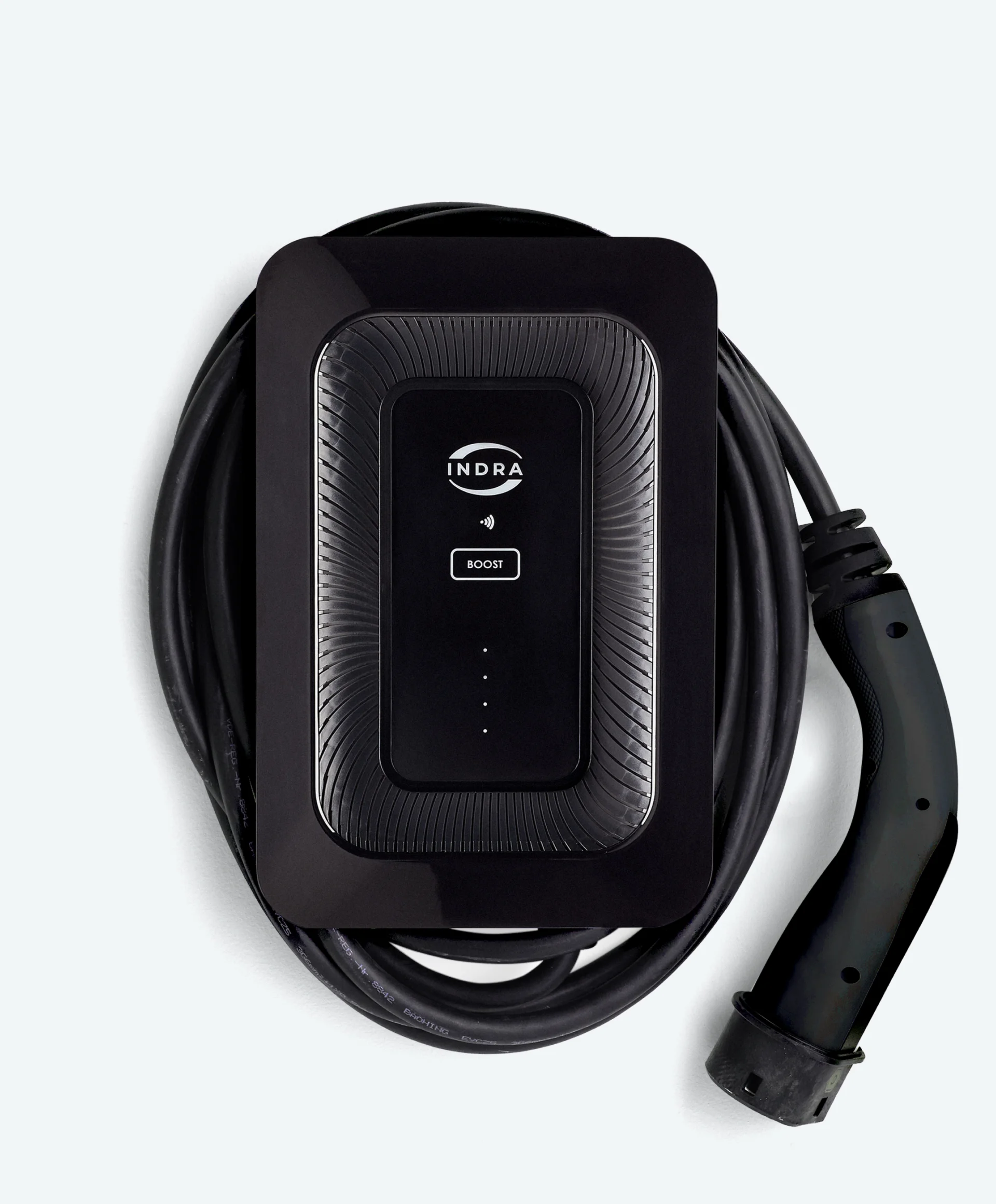
The Smart LUX, by contrast, is a genuinely impressive piece of industrial design. At just 78mm deep, it's the slimmest tethered smart charger on the UK market — it sits almost flush against the wall. It weighs just 3.6kg with the 6m cable and comes in four colour options: Indra White, Symphony Black, Malvern Stone, and Elgar Grey. If your charger is on the front of your house rather than tucked away in a garage, the LUX is the clear winner aesthetically.
Then there's durability. The LUX's IP67 rating means it can survive temporary submersion in water — a significant step up from the PRO's IP54, which covers splashing but not much more. Both carry an IK10 impact rating (the LUX explicitly, the PRO via its robust polycarbonate construction), but for exposed coastal or rural installations where driving rain is a regular occurrence, the LUX's IP67 offers genuine peace of mind. As electriccarguide.co.uk highlights, the LUX also features a distinctive turbine LED lighting system for status indication, replacing the PRO's more conventional membrane panel.
Installation Considerations
The Smart PRO includes a surge protection device (SPD) as standard — and this is a genuinely underappreciated advantage. Since 2022, UK regulations (BS 7671 Amendment 2) require SPDs for most new EV charger installations. If your charger doesn't include one, your electrician will need to fit a separate unit in your consumer unit, typically costing £100-150 in parts and labour. The PRO effectively absorbs that cost, making its real-world price closer to £449-499 when you factor in the saving.
The LUX also includes built-in SPD and PEN fault detection as standard, which similarly simplifies installation. Its estimated installation cost of £300-500 is slightly lower than the PRO's £400-600 range, likely reflecting the LUX's lighter weight and slimmer profile making it easier to mount. Both chargers support dynamic load balancing to protect your home's electrical supply.
One practical note: the LUX offers a 10m cable option, which is valuable if your parking spot is further from the charger location. The PRO comes with a 6m cable as standard, though it's also available in untethered form — something the LUX doesn't offer. If you own multiple EVs with different connector types, or simply prefer the tidier look of an untethered socket, the PRO gives you that flexibility.
Price and Value
| Cost Element | Indra Smart PRO | Indra Smart LUX |
|---|---|---|
| Unit price (supply only) | £599 | £615 (10m) / from £670 (6m) |
| Typical installation | £400–600 | £300–500 |
| Total installed estimate | £999–1,199 | £915–1,175 |
| After OZEV grant (if eligible) | £349–549 | £415–675 |
The pricing picture is surprisingly close. The PRO's included SPD narrows the gap further in practice, since installers won't need to add one separately. The LUX's lower installation estimate and the option to buy the 10m cable version at £615 supply-only makes it competitive despite its premium positioning. For eligible renters and flat owners, the OZEV grant knocks £500 off either option, potentially bringing the total below £600 — excellent value for a British-made smart charger with solar integration.
Who Should Buy Which?
Buy the Indra Smart PRO if:
- You want an untethered socket option for flexibility with multiple vehicles
- You value the included SPD saving you £100-150 on installation costs
- You prefer a proven, established product with a track record
- You're happy with a straightforward, no-frills approach to smart charging
- You're interested in Indra's V2G ecosystem for potential future upgrades
Buy the Indra Smart LUX if:
- Your charger will be visible on the front of your house and aesthetics matter
- You need maximum weather protection — the IP67 rating is best-in-class for a home charger
- You want the widest possible smart tariff compatibility (1,000+ tariffs)
- You need a longer cable — the 10m option is a genuine practical advantage
- You value OCPP 1.6 support for potential future flexibility with energy platforms
Our recommendation: For most UK homeowners, the Indra Smart LUX edges it. The £16 price difference on supply-only is negligible, and you get a significantly slimmer design, superior IP67 weatherproofing, and broader tariff integration. The turbine LED system and four colour choices are nice touches that make it feel like a genuinely premium product. However, if you specifically need an untethered charger, or if the SPD saving tips the value equation in your favour, the Smart PRO remains a thoroughly capable and honest choice. Both are excellent examples of British EV charging engineering.
For the full specs-level breakdown, see our Indra Smart PRO vs Indra Smart LUX comparison page.
Read our full Indra Smart PRO review or Indra Smart LUX review.
If you have solar panels, see our best EV charger for solar panels guide.
We’ll handle the installation
We’ll match you with vetted UK electricians — up to 3 free quotes, no obligation.