myenergi Zappi GLO vs VCHRGD Seven Pro: Solar Pedigree vs Budget Brilliance
Solar Pedigree vs Budget Brilliance: Which Smart Charger Deserves Your Driveway?
Here's a comparison that would have been unthinkable two years ago. The myenergi Zappi has long been the undisputed king of solar EV charging in the UK — a charger so dominant in its niche that "Zappi" has practically become shorthand for "solar charger." But the VCHRGD Seven Pro has arrived with a provocative proposition: solar integration, smart tariff support, dynamic load balancing, RFID access, and OCPP compliance — all for barely half the price.
So is the Zappi GLO still worth the premium, or has the VCHRGD Seven Pro rendered it overpriced? The answer depends on how seriously you take your solar setup — and how much you trust a newer brand with your daily charging needs.
In a nutshell:
- myenergi Zappi GLO (£599): The UK's most proven solar EV charger, with three charging modes and deep integration into myenergi's whole-home energy ecosystem.
- VCHRGD Seven Pro (£432): A feature-packed newcomer that delivers solar charging, smart tariffs, and dynamic load balancing at a price that undercuts almost every rival.
Spec Comparison
| Feature | myenergi Zappi GLO | VCHRGD Seven Pro |
|---|---|---|
| Price (unit only) | £599 | £432 (tethered 7.5m) / £395 (untethered) |
| Max Power | 7kW (single-phase) / 22kW (three-phase) | 7.4kW (single-phase only) |
| Cable Length | 6.5m (tethered) | 7.5m (tethered) |
| Smart Tariff Support | Yes — Intelligent Octopus Go compatible | Yes — Octopus Intelligent Go compatible |
| Solar Modes | Eco, Eco+, Fast | Solar Export, Solar Only |
| Connectivity | Wi-Fi, Bluetooth | Wi-Fi, Bluetooth (optional 4G) |
| RFID | Yes — up to 126 users | Yes — 2 cards included |
| Dynamic Load Balancing | Yes | Yes — CT clamp included |
| Warranty | 3 years | 3 years |
| IP Rating | IP65 | IP54 + IK10 |
| Tethered/Untethered | Both available | Both available |
| Weight | ~5.4 kg | ~4 kg |
Solar Diversion: The Headline Battle
This is where the Zappi GLO has built its reputation, and it remains genuinely best-in-class. The three charging modes — Fast, Eco, and Eco+ — give solar panel owners granular control over how their surplus energy is used. Eco+ is the standout: it charges your EV exclusively from surplus solar generation, meaning you can top up your Tesla for literally nothing on a sunny day. Eco mode blends solar and grid power, ensuring your car charges at a reasonable rate even when the clouds roll in. As electriccarguide.co.uk notes, the Zappi scores 9/10 for performance thanks to this versatile solar charging capability.
The VCHRGD Seven Pro isn't without solar credentials, though. It offers two modes — Solar Export and Solar Only — and includes a CT clamp in the box for monitoring your generation. Solar Only mirrors the Zappi's Eco+ by charging purely from surplus, while Solar Export functions similarly to Eco mode. For many households with a standard 4kW solar array, these two modes will cover the vast majority of use cases.
Where the Zappi pulls ahead is ecosystem depth. Pair it with myenergi's eddi hot water diverter or libbi home battery, and you've got a complete home energy management system that intelligently distributes every watt of solar generation. The VCHRGD Seven Pro, while competent on its own, doesn't offer anything comparable. If you're building a whole-home renewable energy setup, the Zappi GLO is the foundation stone. If you simply want to charge from solar when the sun shines and from the grid when it doesn't, the VCHRGD does the job at a significant saving.
Smart Tariff Integration
Both chargers support Intelligent Octopus Go, which is the gold standard for UK EV smart tariffs. This means both can take advantage of off-peak electricity at around 7p/kWh — compared to roughly 24p/kWh on a standard variable tariff. For a typical Tesla Model 3 driver covering 7,400 miles a year, that's the difference between roughly £150 and £500 in annual charging costs. As autochain.co.uk highlights, the Zappi is recognised as one of the best chargers for Octopus tariffs, particularly for solar homes.
The VCHRGD Seven Pro also supports OCPP 1.6J, an open communication protocol that allows it to connect to third-party energy management platforms. This is a genuinely useful feature for future-proofing — if a new smart tariff or energy platform emerges, OCPP compatibility means the Seven Pro can likely support it without waiting for a firmware update from VCHRGD. The Zappi GLO doesn't offer OCPP, relying instead on myenergi's own app and ecosystem for smart functionality.
App and Connectivity
The Zappi GLO has ditched the on-unit LCD screen that featured on the older Zappi 2.1, moving all control to the myenergi app. This is a cleaner design choice, but some users who upgraded from the 2.1 have found it a step backwards — there's something reassuring about glancing at a screen to check charging status without reaching for your phone. The myenergi app itself has improved significantly over the years, but it still isn't quite as slick as the best in the business.
The VCHRGD Seven Pro uses the Powerverse app, which includes a Raya AI assistant for energy optimisation. It's a modern, capable platform, but it does introduce a dependency — if the Powerverse partnership were to change, it could affect the charger's smart functionality. The Seven Pro also offers optional 4G connectivity, which is a genuine advantage over the Zappi GLO's Wi-Fi-only setup. If your charger is at the far end of a long driveway where Wi-Fi signal is patchy, that 4G option could save you considerable frustration.
Build Quality and Design
The Zappi GLO is IP65 rated — fully protected against dust and water jets from any direction. It's a proven design built by a well-established British manufacturer with years of field data behind it. At 439mm × 282mm × 130mm, it's not the most compact charger on the market, but it's solidly built and available in both black and white.
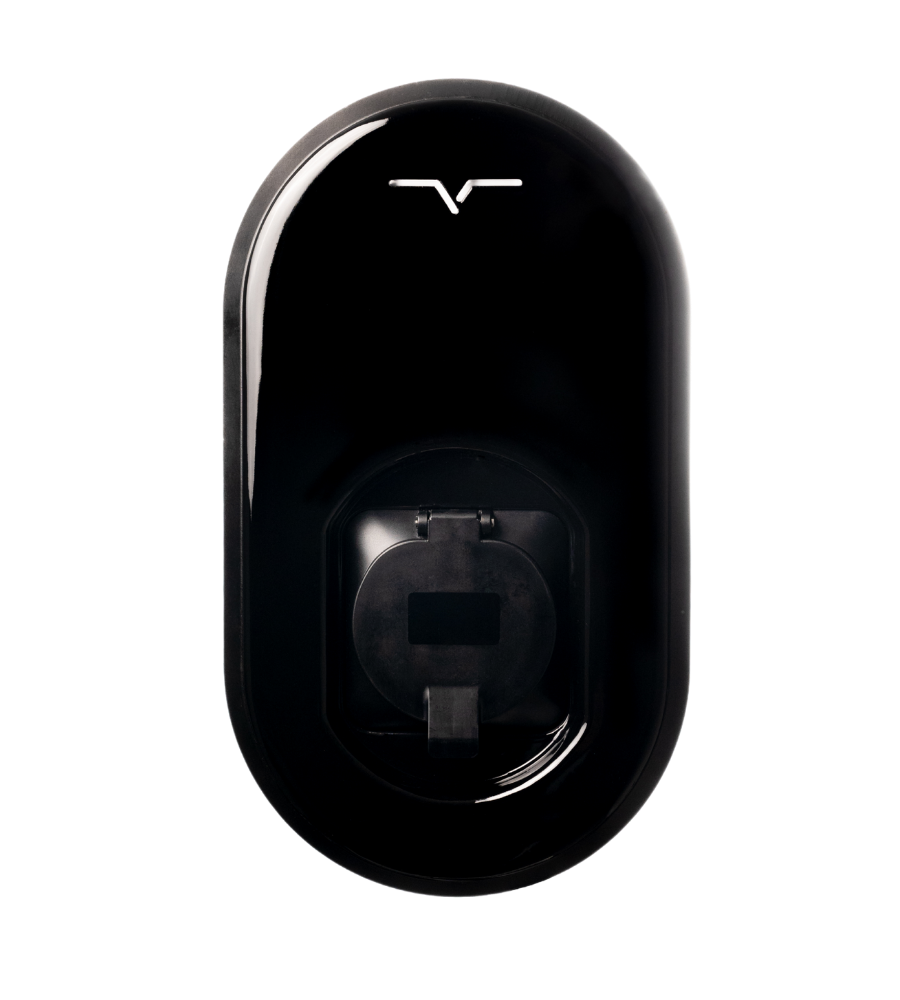
The VCHRGD Seven Pro is noticeably smaller (300mm × 180mm × 90mm) and lighter at around 4 kg. Its IP54 rating is a step below the Zappi's IP65 — it's protected against splashing water but not direct jets. However, it compensates with an IK10 impact resistance rating, meaning it can withstand significant knocks. It's only available in black, which may or may not suit your home's exterior. For most UK installations under a carport or on a sheltered wall, IP54 is perfectly adequate, but if your charger will be fully exposed to the elements, the Zappi's IP65 offers extra peace of mind.
Price and Value
| Cost Breakdown | myenergi Zappi GLO | VCHRGD Seven Pro |
|---|---|---|
| Unit price | £599 | £432 |
| Typical installation | £400–£600 | £400–£600 |
| Total installed cost | £999–£1,199 | £832–£1,032 |
| After OZEV grant (if eligible) | £349–£549 | £332–£532 |
The price gap is stark: £347 at the unit level, and the same once installed. That's a significant sum — enough to cover roughly two years of off-peak charging costs on Octopus Intelligent Go. The VCHRGD Seven Pro also includes a CT clamp in the box and offers a longer 7.5m tethered cable versus the Zappi's 6.5m, sweetening the value proposition further.
The Zappi GLO justifies its premium primarily through its deeper solar ecosystem integration and its track record. myenergi is a well-known, well-supported UK brand; the Zappi has been installed in hundreds of thousands of homes. That maturity carries real value in terms of long-term support, spare parts availability, and installer familiarity. VCHRGD is newer, and while the Seven Pro's spec sheet is impressive, only time will tell whether the brand delivers the same level of long-term reliability and support.
Who Should Buy Which?
Buy the myenergi Zappi GLO if:
- You have solar panels and want the most proven, refined solar charging experience available
- You're building a myenergi ecosystem with eddi or libbi for whole-home energy management
- You have or plan to install three-phase power and want the 22kW option
- You value brand maturity and a large UK installer network
- You need RFID access for a large number of users (up to 126)
Buy the VCHRGD Seven Pro if:
- You want solar charging capability without paying the Zappi premium
- Budget is a primary concern and you want the most features per pound
- You value OCPP compatibility for future-proofing and platform flexibility
- You need a longer cable (7.5m vs 6.5m) or a more compact unit
- You want the option of 4G connectivity for unreliable Wi-Fi locations
Our recommendation: For most UK buyers — including those with solar panels — the VCHRGD Seven Pro represents extraordinary value. It covers the essential solar modes, supports Intelligent Octopus Go, includes dynamic load balancing with a CT clamp, and does it all for £347 less than the Zappi GLO. However, if you're serious about maximising every watt of solar generation and want to build out a complete myenergi home energy ecosystem, the Zappi GLO remains the charger to beat. Its pedigree, ecosystem depth, and IP65 rating justify the premium for committed solar households. For everyone else, the VCHRGD Seven Pro is the smarter spend.
For the full specs-level breakdown, see our myenergi Zappi GLO vs VCHRGD Seven Pro comparison page.
Read our full myenergi Zappi GLO review or VCHRGD Seven Pro review.
If you have solar panels, see our best EV charger for solar panels guide.
For total installed cost rankings, see our cheapest EV charger guide.
We’ll handle the installation
We’ll match you with vetted UK electricians — up to 3 free quotes, no obligation.