Wallbox Pulsar Max vs Rolec EVO: Compact Premium vs UK Value Champion
Compact Premium vs UK-Built Value: Two Smart Chargers, £250 Apart
The Wallbox Pulsar Max and the Rolec EVO sit at opposite ends of a fascinating spectrum. Both are well-engineered smart chargers with 5-year warranties, solar integration, and dynamic load balancing. Both carry IP54 and IK10 ratings, meaning they can handle British weather and the occasional clumsy bump from a wheelie bin. Yet there is a £250 gap between them — and that gap tells an interesting story about what you are actually paying for.
The Wallbox Pulsar Max is the successor to the hugely popular Pulsar Plus, which shifted over 400,000 units worldwide according to wepoweryourcar.com. It trades on its impossibly compact design, three-phase capability, and polished app experience. The Rolec EVO, meanwhile, is a proudly UK-designed and manufactured charger from an established Lincolnshire company, and it packs a frankly remarkable feature set — including built-in PME fault detection, OCPP support, and a CT clamp for load balancing — into a unit that costs less than many "basic" chargers. If you are weighing these two up, you are essentially asking: do I want a refined, compact premium product, or do I want maximum features per pound?
In a nutshell:
- Wallbox Pulsar Max (£496): The most compact charger on the market with three-phase capability and voice control — ideal where wall space is tight or aesthetics matter most.
- Rolec EVO (£449): Outstanding value from a UK manufacturer, with solar integration, dynamic load balancing, and PME fault detection all included as standard.
Spec Comparison
| Feature | Wallbox Pulsar Max | Rolec EVO |
|---|---|---|
| Price (unit only) | £496 | £449 |
| Max Power Output | 7.4kW (single-phase) / 22kW (three-phase) | 7.4kW (single-phase only) |
| Cable Type | Tethered (Type 2, 5m) | Untethered (Type 2 socket) |
| Smart Tariff Integration | No built-in tariff integration | No built-in tariff integration |
| Solar Integration | Eco-Smart (requires separate Power Meter) | Eco & Eco+ modes (CT clamp included) |
| Connectivity | Bluetooth, Wi-Fi | Wi-Fi 6, Bluetooth 5.0, Ethernet |
| Warranty | 5 years | 5 years |
| IP / IK Rating | IP54 + IK10 | IP54 + IK10 |
| Type | Tethered or untethered | Untethered only |
| PME/PEN Fault Detection | Not specified | Built-in |
| OCPP Support | Not specified | OCPP 1.6J |
| Voice Control | Alexa & Google Assistant | Not specified |
Solar Integration: Included vs Extra Cost
Both chargers offer solar integration, but the implementations differ significantly in cost and complexity. The Rolec EVO ships with Eco and Eco+ modes and, crucially, includes the CT clamp in the box. This means your installer can set up solar diversion during the standard installation with no additional hardware purchase. If you have a 4kW solar array and want to soak up surplus generation during the day, the EVO handles this out of the box.
The Wallbox Pulsar Max offers its Eco-Smart feature for solar integration, but it requires a separate Wallbox Power Meter — an additional cost on top of the £496 unit price. As wallbox.com notes, the Pulsar Max can connect with solar and home battery systems, but the extra hardware requirement means the total investment for solar-aware charging is notably higher than with the Rolec.
For anyone with existing solar panels — or planning to install them — this is a meaningful difference. The Rolec EVO gives you solar diversion capability for £449 all-in, while the Pulsar Max will cost £496 plus the Power Meter before you even think about installation.
Build Quality, Design, and Installation
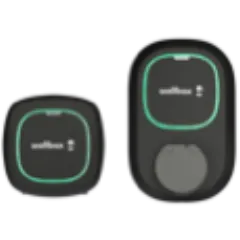
The Wallbox Pulsar Max is genuinely tiny. At 198mm × 201mm × 99mm, it is one of the smallest home chargers you can buy, and electriccarguide.co.uk praised the Wallbox range for its minimal, unobtrusive aesthetic. It is available in six colours, which is a rare touch in a market dominated by black and white boxes. The RGB LED halo gives clear charging status feedback. If your charger will be on a prominent front wall or a narrow driveway, the Pulsar Max is hard to beat for visual discretion.
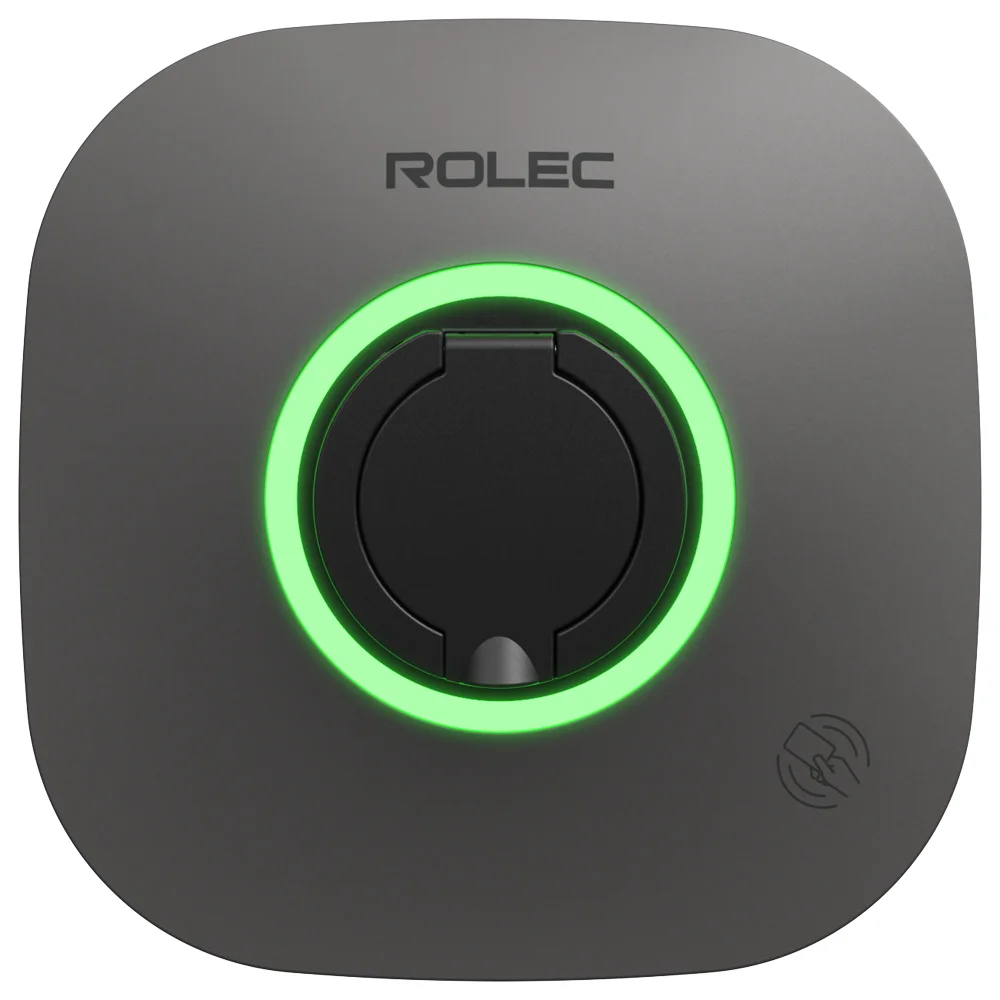
The Rolec EVO is slightly larger at 260mm × 260mm × 112mm but still compact by industry standards, and at just 3 kg it is lighter than the Pulsar Max (approximately 4.2 kg). The EVO won a Red Dot Award in 2024 for its design, so it is no ugly duckling either.
On the installation front, the Rolec EVO has a clear advantage: built-in PME/PEN fault detection eliminates the need for a separate PEN protection device or earth rod. As electriccarguide.co.uk noted about the Pulsar Plus (which also featured this), skipping the earth rod saves £100–200 on installation and keeps the setup cleaner. The EVO also includes built-in Type A RCD with 6mA DC protection, potentially saving further on consumer unit upgrades. The Pulsar Max data does not confirm built-in PEN fault detection, so you may need to budget for this separately.
App, Connectivity, and Smart Features
The Wallbox myWallbox app is a mature, well-regarded platform. As bestchargers.co.uk highlights, the Pulsar Max offers remote control, energy monitoring, and charge scheduling through the app. Voice control via Alexa and Google Assistant is a genuine differentiator — handy if you are already embedded in a smart home ecosystem. Bluetooth and Wi-Fi connectivity cover most home setups.
The Rolec EVO counters with Wi-Fi 6, Bluetooth 5.0, and — notably — an Ethernet port. Ethernet is a welcome addition for anyone whose charger location has poor Wi-Fi signal, which is more common than you might think when the charger sits on an external garage wall 15 metres from the router. The EVO also supports OCPP 1.6J, an open protocol that could prove valuable if you ever want to connect to third-party charging management platforms. Two RFID cards are included, useful if you want to restrict access or track usage between household members.
The trade-off? The Rolec EVO app is still maturing. As a newer product, the software experience does not yet match the polish of the myWallbox app. Neither charger offers built-in smart tariff integration in the style of the Ohme, so if automatic Octopus Intelligent Go or Agile optimisation is your priority, both will require manual scheduling.
Power and Charging Speed
For the vast majority of UK homes on single-phase power, both chargers deliver the same 7.4kW output. That means roughly 8.5 hours to fully charge a typical 60kWh EV battery — comfortably overnight on any smart tariff.
The Wallbox Pulsar Max pulls ahead if you are one of the small percentage of UK homes with three-phase power, where it can deliver up to 22kW. At that speed, the same 60kWh battery charges in approximately 2.7 hours. The Rolec EVO is single-phase only, so this is a non-starter if three-phase matters to you.
Both chargers include dynamic load balancing — Power Boost on the Wallbox, CT clamp-based on the Rolec — which prevents your main fuse from tripping during heavy household electrical use. This is particularly valuable in older UK homes with 60A or even 80A main fuses.
Price and Value
| Cost Element | Wallbox Pulsar Max | Rolec EVO |
|---|---|---|
| Unit price | £496 | £449 |
| Typical installation | £400–£600 | £400–£600 |
| Total installed cost | £896–£1,096 | £849–£1,049 |
| After OZEV grant (if eligible) | £396–£596 | £349–£549 |
The £47 unit price difference is modest, but the Rolec EVO's built-in PME fault detection (saving £100–200 on installation) and included CT clamp for solar integration widen the gap. A fully installed Rolec EVO with solar capability could realistically cost £100–250 less than a similarly equipped Pulsar Max.
The Wallbox Pulsar Max justifies its slightly higher price through its ultra-compact design, three-phase capability, voice control, and the maturity of its app ecosystem. If those features matter to you, the extra spend is defensible. But on a pure features-per-pound basis, the Rolec EVO is hard to beat.
Who Should Buy Which?
Buy the Wallbox Pulsar Max if:
- You have three-phase power and want to charge at up to 22kW
- Wall space is extremely limited and you need the smallest possible charger
- You want voice control through Alexa or Google Assistant
- Aesthetics are a priority — six colour options let you match your home
- You prefer a tethered charger with the cable permanently attached
Buy the Rolec EVO if:
- You want the best value smart charger with solar integration included
- You have or plan to install solar panels and want diversion without extra hardware
- You prefer an untethered socket for flexibility across multiple EVs or cable lengths
- You value Ethernet connectivity for a reliable connection in tricky Wi-Fi spots
- You want to support a UK manufacturer with a proven track record
Our recommendation: For most UK homeowners on single-phase power, the Rolec EVO represents the smarter purchase. It delivers a feature set — solar integration, dynamic load balancing, PME fault detection, OCPP, RFID — that rivals chargers costing £200–300 more, all backed by a 5-year warranty from an established British manufacturer. The app needs further refinement, but the hardware and value proposition are genuinely impressive. The Wallbox Pulsar Max earns its place if you need three-phase charging, have tight wall space, or simply want the most compact, polished unit available — but at £496, you are paying a premium for design and flexibility that not everyone will need.
For the full specs-level breakdown, see our Wallbox Pulsar Max vs Rolec EVO comparison page.
Read our full Wallbox Pulsar Max review or Rolec EVO review.
We’ll handle the installation
We’ll match you with vetted UK electricians — up to 3 free quotes, no obligation.