Tesla Wall Connector (Gen 3) vs VCHRGD Seven Pro: Brand Power vs Feature King
Brand Power vs the Feature King: Which Charger Deserves Your Wall?
On paper, these two chargers shouldn't really be rivals. One carries the most recognisable name in electric vehicles; the other comes from a newer brand most people haven't heard of yet. But the VCHRGD Seven Pro has been turning heads precisely because it packs an almost absurd number of features into a box that actually costs *less* than the Tesla Wall Connector Gen 3. That's a bold proposition — and it's exactly why so many UK EV owners are weighing up these two against each other.
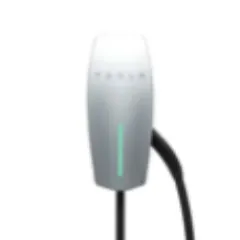
The Tesla Wall Connector (Gen 3) is the official home charger from Tesla itself, offering seamless app integration and a reassuringly long warranty at a competitive £425. The VCHRGD Seven Pro, at £432 tethered, counters with smart tariff support, built-in solar diversion, dynamic load balancing, and RFID access — features you'd normally expect from chargers costing £200 more. So which one actually makes more sense for your home?
In a nutshell:
- Tesla Wall Connector (Gen 3) (£425): The slickest Tesla ownership experience with unmatched app integration, power sharing for up to six units, and a class-leading 4-year warranty.
- VCHRGD Seven Pro (£432): The most feature-packed charger at this price, with solar diversion, smart tariff integration, dynamic load balancing, and RFID — all included as standard.
Spec Comparison
| Feature | Tesla Wall Connector (Gen 3) | VCHRGD Seven Pro |
|---|---|---|
| Price (unit only) | £425 | £432 (tethered 7.5m) / from £395 (untethered) |
| Max Power | 7.4kW (single-phase) / 22kW (three-phase) | 7.4kW (single-phase only) |
| Cable Length | 7.3 metres | 7.5 metres |
| Smart Tariff Integration | No (manual scheduling only) | Yes (Octopus Intelligent Go) |
| Solar Diversion | No (requires additional hardware) | Yes (Solar Export + Solar Only modes, CT clamp included) |
| Connectivity | Wi-Fi | Wi-Fi, Bluetooth (optional 4G) |
| App | Tesla app | Powerverse app (with Raya AI assistant) |
| RFID Access | No | Yes (2 cards included) |
| Dynamic Load Balancing | No (power sharing up to 6 units) | Yes (CT clamp included) |
| OCPP Support | No | Yes (OCPP 1.6J) |
| Warranty | 4 years | 3 years |
| IP Rating | IP44 | IP54 + IK10 |
| Weight | 5.3 kg | ~4 kg |
| Type | Tethered (Type 2) | Tethered or Untethered (Type 2) |
Smart Tariff Integration
This is where the VCHRGD Seven Pro opens up a meaningful gap. It integrates directly with Octopus Intelligent Go — one of the UK's most popular EV tariffs, offering electricity at around 7p/kWh during off-peak hours. The charger communicates with the tariff via the Powerverse app, automatically scheduling your charging sessions to hit those cheap overnight slots without you having to think about it. For a typical Tesla Model 3 with a 60kWh battery, that's roughly £4.20 for a full charge — enough for around 210 miles of range viablepower.co.uk.
The Tesla Wall Connector, by contrast, has no built-in smart tariff integration. You can set scheduled charging times through the Tesla app, which works perfectly well if you're on a simple off-peak tariff like Octopus Go (7.5p/kWh between 00:30 and 04:30) — just set it to start at half midnight and you're sorted. But if you want the dynamic, price-responsive charging that tariffs like Octopus Intelligent Go or Octopus Agile offer, the Tesla Wall Connector can't do that natively. You'd need to rely on the Tesla Energy plan or third-party workarounds. For drivers who want true set-and-forget tariff optimisation, the VCHRGD has a clear advantage here.
Solar Diversion
If you've got solar panels on your roof — or you're planning to install them — this comparison isn't even close. The VCHRGD Seven Pro includes two dedicated solar charging modes: Solar Export, which diverts excess solar generation to your car rather than sending it back to the grid, and Solar Only, which charges exclusively from solar power. The CT clamp needed for this functionality comes included in the box, saving you from buying one separately tinyeco.com.
The Tesla Wall Connector has no solar diverting capability without additional hardware. If you're a Tesla Powerwall owner, you can manage energy flows through the broader Tesla ecosystem, but the Wall Connector itself won't divert surplus solar to your car on its own.
Given that the average UK solar installation generates meaningful surplus during spring and summer months, the VCHRGD's solar modes could save you hundreds of pounds annually in avoided grid electricity costs — effectively charging your car for free on sunny days.
App and Connectivity
The Tesla app experience is, frankly, superb — and it extends well beyond just the charger. If you own a Tesla, your car, your charger, and your energy data all live in one beautifully designed app. You get charging schedules, session history, notifications, and over-the-air updates that can add new features over time. The power sharing feature is also managed through the Tesla ecosystem, allowing up to six Wall Connectors to share a single circuit — a genuinely useful feature for households with multiple EVs qualityheating.co.uk.
The VCHRGD Seven Pro uses the third-party Powerverse app, which includes an AI assistant called Raya. It supports scheduled charging, solar monitoring, and tariff integration. The charger also connects via both Wi-Fi and Bluetooth, with optional 4G connectivity. OCPP 1.6J support means it can connect to multiple third-party management platforms, giving it flexibility the Tesla lacks. However, the reliance on Powerverse does introduce a dependency — if that platform changes direction or shuts down, the charger's smart features could be affected. It's a legitimate consideration for a product you'll own for a decade or more.
Build Quality and Design
Both chargers are rated for outdoor installation, but their protection levels differ. The VCHRGD Seven Pro is OZEV-approved; the Tesla Wall Connector is not. The Tesla carries an IP44 rating — adequate for sheltered outdoor use but not the most robust against heavy rain or jet washing. The VCHRGD Seven Pro steps up to IP54 with an IK10 impact resistance rating, meaning it's better protected against dust ingress, water splashes, and physical knocks. If your charger will be mounted on an exposed driveway wall, that extra protection is worth noting.
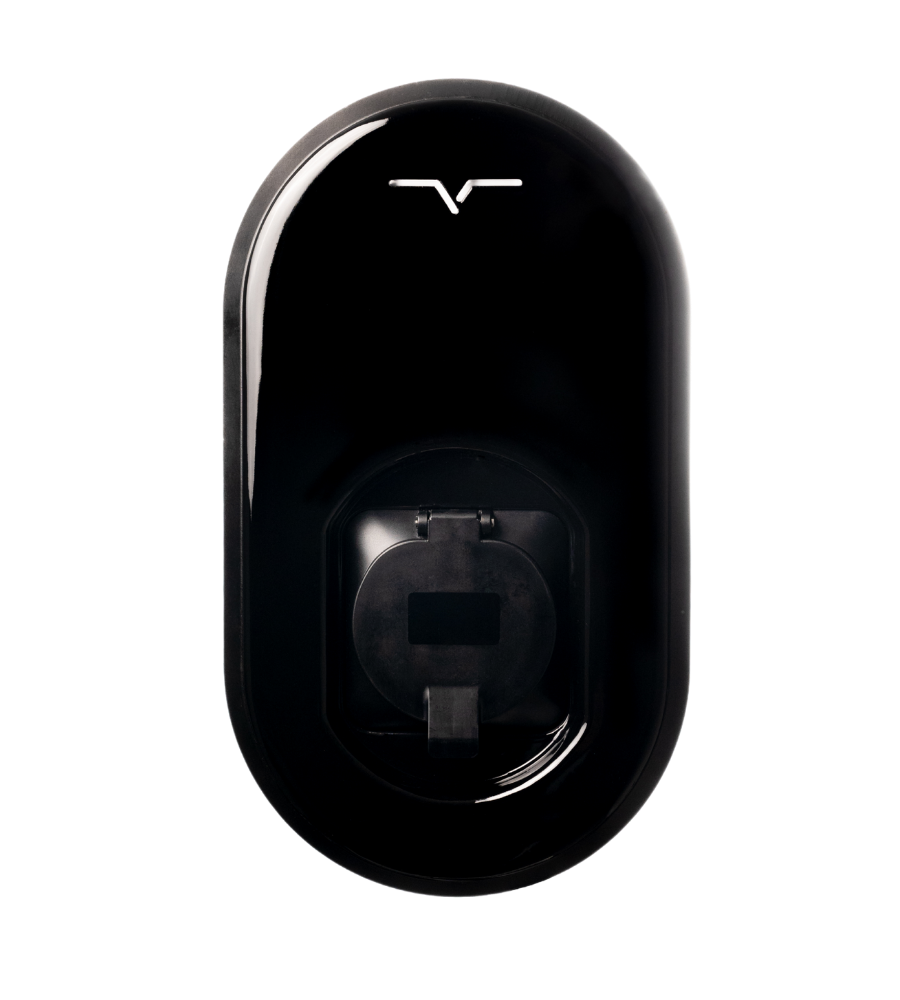
The VCHRGD is also lighter at roughly 4 kg versus 5.3 kg, and more compact at 300mm × 180mm × 90mm compared to the Tesla's 353mm × 152mm × 124mm. Both are perfectly manageable, but the VCHRGD has a slight edge in discreetness. The trade-off? It only comes in black, whereas the Tesla Wall Connector's minimalist white design has become something of a status symbol on driveways across the UK.
Price and Value
| Cost Element | Tesla Wall Connector (Gen 3) | VCHRGD Seven Pro |
|---|---|---|
| Unit Price | £425 | £432 (tethered) / from £395 (untethered) |
| Typical Installation | £400–£600 | £400–£600 |
| Total Installed Cost | £825–£1,025 | £832–£1,032 |
| After OZEV Grant (£500) | Not eligible | £332–£532 |
The Tesla Wall Connector is not OZEV-approved, so grant-eligible buyers will find the VCHRGD significantly cheaper after the £500 grant. The VCHRGD Seven Pro is £7 cheaper at the unit level — a modest saving on its own. But when you factor in what's included for that money — solar diversion with CT clamp, dynamic load balancing, RFID cards, smart tariff integration, and OCPP support — the value gap widens considerably. To get equivalent functionality from the Tesla Wall Connector, you'd need additional hardware and workarounds for solar and tariff features.
That said, the Tesla's 4-year warranty versus the VCHRGD's 3 years does offset some of that value advantage. An extra year of coverage provides peace of mind, particularly given that VCHRGD is a relatively new brand without the long-term reliability track record that Tesla's charger hardware has established voltsmonster.com.
Who Should Buy Which?
Buy the Tesla Wall Connector (Gen 3) if:
- You own a Tesla and want everything managed in one seamless app
- You have (or plan to have) multiple EVs and need power sharing for up to 6 chargers on one circuit
- You have a three-phase supply and want to unlock 22kW charging speeds
- You value brand longevity and a 4-year warranty over maximum features
- You don't have solar panels and are happy with simple time-based scheduling
Buy the VCHRGD Seven Pro if:
- You have solar panels and want built-in solar diversion without buying extra kit
- You want automatic smart tariff optimisation with Octopus Intelligent Go
- You share a driveway or parking space and need RFID access control
- You want dynamic load balancing included as standard with the CT clamp
- You're after the most features per pound and don't mind a newer brand
Our recommendation: For the majority of UK EV owners — including Tesla drivers — the VCHRGD Seven Pro offers significantly more functionality for less money. The solar integration alone could save hundreds annually, and the smart tariff support means genuine hands-off savings from day one. However, if you're a Tesla owner who values the polished, unified Tesla app experience and the reassurance of a 4-year warranty from an established brand, the Wall Connector remains an excellent choice — particularly if you have a three-phase supply and can take advantage of its 22kW capability. For everyone else, the VCHRGD Seven Pro is remarkably hard to beat at this price evzapster.com.
For the full specs-level breakdown, see our Tesla Wall Connector (Gen 3) vs VCHRGD Seven Pro comparison page.
Read our full Tesla Wall Connector (Gen 3) review or VCHRGD Seven Pro review.
For total installed cost rankings, see our cheapest EV charger guide.
We’ll handle the installation
We’ll match you with vetted UK electricians — up to 3 free quotes, no obligation.